- Home
- Blog
- Atlanta Generator Transfer Switch Installation: A Backup Power Solution That Really Mattered
Atlanta Generator Transfer Switch Installation: A Backup Power Solution That Really Mattered
Fuse Crew Electrical helped an Atlanta homeowner create a safer backup power plan with a portable generator and 10-circuit manual transfer switch. See how we designed and installed the system around the circuits his family needed most.
For most homeowners, losing power is an inconvenience.
For this Atlanta-area family, it was something entirely different.
When Ted first contacted Fuse Crew Electrical, he wasn't looking for the biggest generator he could buy. He wasn't necessarily looking for an expensive whole-home standby generator either.
He was trying to solve a very specific problem.
His wife relies on essential medical equipment 24 hours a day, and he needed a dependable way to keep that equipment powered when the electricity goes out.
That changed the way we approached the entire project.
Finding the Right Backup Power Solution for an Atlanta Home
This job actually started almost a month before we installed anything.
Ted and I went back and forth by phone and text about generators, fuel types, transfer switches and which circuits he really needed during an outage.
At one point we considered different generator sizes. We talked about an eight-circuit versus a 10-circuit transfer switch. We looked at how much power his equipment would actually require and what else he wanted to keep running.
There were a lot of decisions to make.
But the question we kept coming back to was pretty simple:
What does Ted's family actually need when the power goes out?
That's where we started.
His priorities were the master bedroom where the essential medical equipment is located, his refrigerator and kitchen receptacles, the large freezer in his garage, and the living room circuit that powers his internet equipment.
He didn't necessarily need every light, receptacle and appliance in the house operating during an outage.
He needed the right things operating.
That distinction ended up shaping the entire project.
His Existing Generator Setup Wasn't a Good Long-Term Answer
Ted already had a portable gasoline generator.
The problem wasn't simply the generator. It was what he had to do with it.
During an outage, he was essentially relying on extension cords to get power from the generator outside to the equipment inside the house.
It worked as a temporary solution, but it wasn't something he wanted to keep doing.
The generator was loud. Gasoline gets consumed quickly. And dragging extension cords through a house during a power outage isn't much of a backup-power plan, particularly when some of the equipment on the other end is important to someone's daily medical care.
Ted had also been presented with the option of installing a whole-home standby generator.
Those systems can be excellent. For some homeowners, they're exactly what we would recommend.
But they're also a substantial investment.
The more we talked with Ted, the clearer it became that there was another option that made a lot of sense for his situation.
Why We Recommended a 10-Circuit Manual Transfer Switch
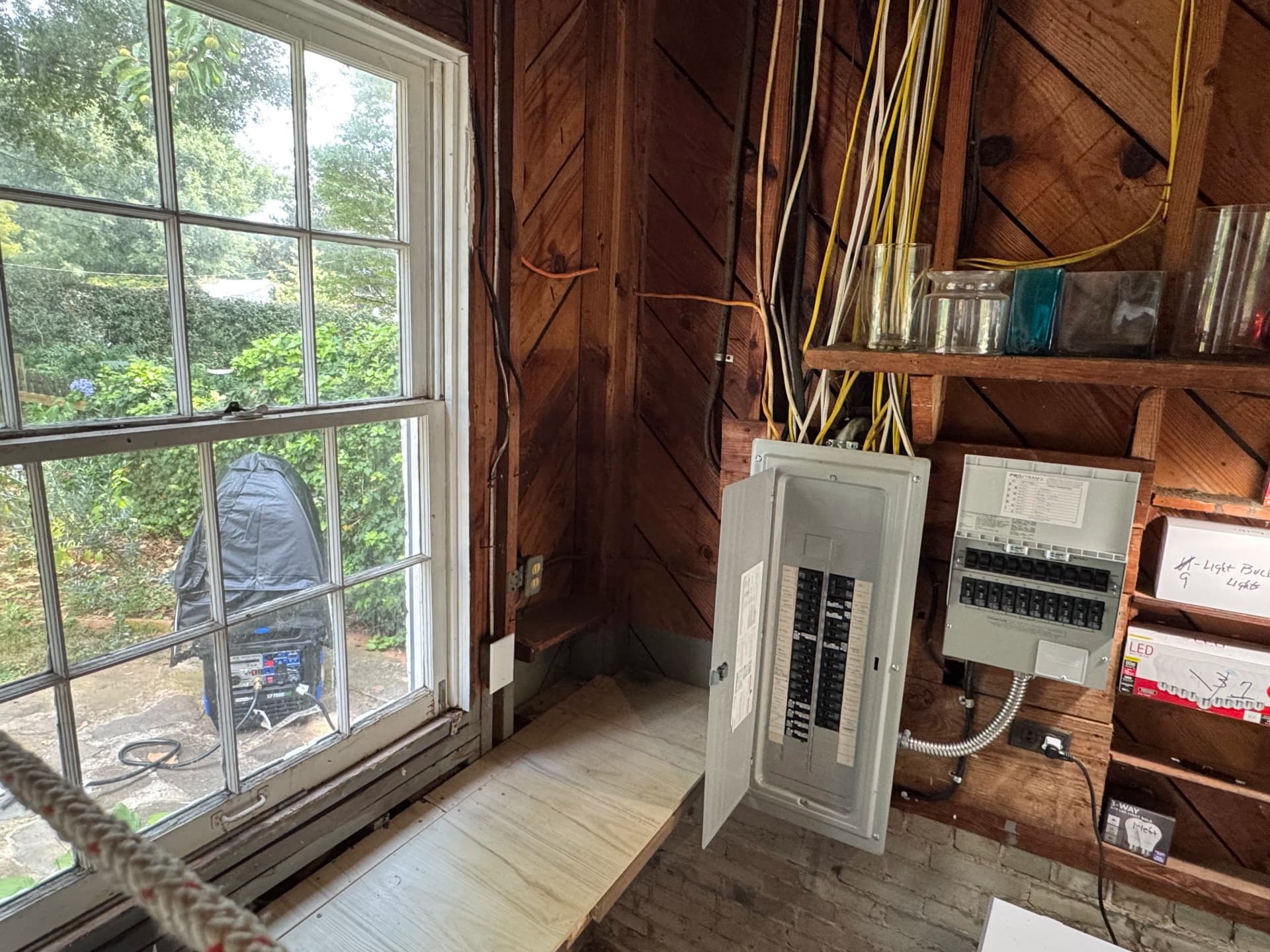
We ultimately settled on a portable propane generator paired with a 10-circuit manual transfer switch.
For Ted, propane offered some advantages over the gasoline generator he had been using, including a much quieter inverter-generator setup and a fuel source he was comfortable storing and managing.
The transfer switch was the other half of the equation.
Instead of trying to power individual pieces of equipment with extension cords, we could connect selected circuits from the home's electrical panel to the generator through the transfer switch.
We installed the transfer switch beside Ted's existing electrical panel in his garage. From there, we ran the necessary wiring through the exterior brick wall and installed a dedicated generator inlet outside.
Now Ted has a permanent connection point for his portable generator.
When utility power goes out, he can safely position the generator outside, connect it to the generator inlet, connect his propane supply and start the generator.
Then, from the transfer switch inside the garage, he can manually select the circuits he needs.
That's a completely different setup from running extension cords through the house.
A 10-Circuit Transfer Switch Doesn't Mean You Run Everything at Once
This was another part of the conversation we thought was important.
Installing a 10-circuit transfer switch doesn't mean a portable generator suddenly has enough capacity to run ten heavily loaded circuits simultaneously.
The transfer switch provides flexibility. The generator still has a finite amount of power available.
That's why we spent time talking with Ted about load management.
During an outage, his wife's essential equipment is the priority. From there, he can operate things like the refrigerator, freezer, internet and other selected loads while being mindful of the generator's capacity.
That's a conversation we believe homeowners should have before buying backup-power equipment.
Buying the biggest transfer switch or the biggest generator isn't automatically the right answer.
You have to look at the house, the electrical panel, the generator and, most importantly, what you're actually trying to keep running.
The Installation Took About Six to Seven Hours. Then Came the Important Part.
Once we had the plan figured out, the actual generator transfer switch installation in Atlanta took our crew roughly six to seven hours.
But we weren't finished when the last connection was made.
We wanted Ted to operate the system himself.
So we fired up the generator and tested everything.
We made sure the transfer switch worked properly. We checked the selected circuits. Then we walked Ted through the process of connecting the generator, starting it and using the manual transfer switch.
That mattered to us on this particular job.
The first time Ted has to depend on this system could be at night, during a bad Atlanta thunderstorm, with the neighborhood already dark.
That's a terrible time to learn how your backup-power system works.
We wanted him to have already done it.
What Ted Said After the Installation
After we finished the project, Ted left Fuse Crew Electrical a five-star review:
“The Fuse Crew did an outstanding job putting in a transfer switch for my portable generator. They made sure everything worked and showed me how to use it. They were thoughtful and easy to work with. I will call them again for any other electrical work.”
That review meant a lot to us, particularly the line about showing him how to use it.
We had spent weeks helping Ted figure out the right solution before we ever started the installation. Once it was installed, we wanted him to understand the system well enough that he wouldn't have to figure it out under pressure.
We tested it with him.
We started the generator.
We transferred the circuits.
We made sure Ted knew what to do.
That's when we considered the job finished.
Do You Need a Whole-Home Generator?
Not necessarily.
And that's probably the biggest lesson we took away from this project.
We're not against whole-home standby generators. There are homes and situations where they're absolutely worth the investment.
But homeowners looking for backup power should know that's not their only option.
If what you really want is the ability to maintain several important circuits during an outage, a properly sized portable generator paired with a professionally installed manual transfer switch can be a very practical alternative.
It can also represent a considerable cost savings compared with installing a permanent whole-home standby generator.
But the system needs to be designed correctly.
Before we recommend one, we want to know things like:
What generator are you using?
How much continuous power can it actually produce on the fuel you intend to use?
Does it provide the voltage required for the system?
Which circuits are truly important during an outage?
What equipment will be operating on those circuits?
Where can the generator be safely operated outside?
Where should the exterior generator inlet be installed?
And can the homeowner comfortably operate the system when we're not standing beside them?
Those questions aren't answered by simply buying a generator at a big-box store.
They're the difference between owning a generator and having an actual backup-power plan.
Generator Transfer Switch Installation in Atlanta
If you already have a portable generator, or you're considering buying one, Fuse Crew Electrical can help you determine whether a manual transfer switch makes sense for your Atlanta-area home.
We'll look at your electrical panel, your generator and the circuits you want available during an outage. If you're still shopping for a generator, we can also help you think through what you actually need before you spend the money.
Sometimes the answer may be a larger backup-power system.
Sometimes it's not.
Ted didn't need us to sell him the most expensive option available.
He needed us to listen to what was happening in his home, think through the problem with him, install the right equipment and make sure he knew how to use it.
For us, that's what good electrical work looks like.
Fuse Crew Electrical
Wired Right, Powered Bright.